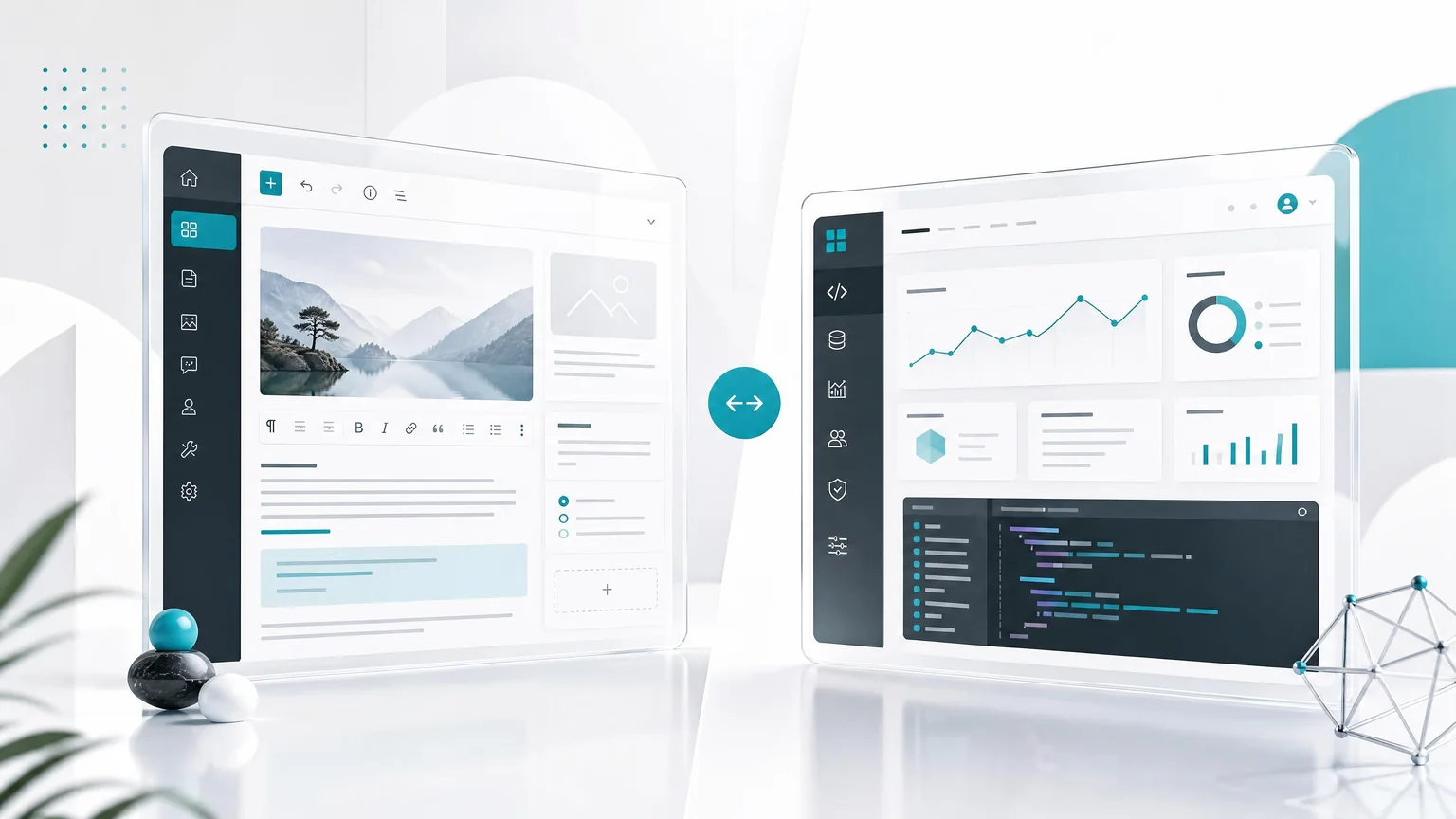
Start with how your team and customers will use the product: WordPress makes content management straightforward, while Symfony supports specific business rules, interfaces and integrations.
WordPress and Symfony: understanding the two approaches
WordPress is primarily a content management system, also known as a CMS. It lets you create pages, publish articles, manage images and administer a website through an accessible interface. Themes control the appearance, while plugins add particular features.
Symfony is a PHP development framework. It provides a structure and reusable components for building websites and web applications around the rules of a project. Unlike WordPress, it does not include a complete editorial interface by default: that interface needs to be designed and developed for your requirements.
This distinction does not mean that WordPress and custom development are mutually exclusive. A WordPress website can be extensively customised, with a bespoke theme, dedicated development and an adapted architecture. The real question is which foundation will meet your current and future needs effectively.
WordPress describes itself as a solution that can be used with limited configuration while remaining customisable. Symfony presents itself as a set of PHP components and a framework for creating web applications.
When might WordPress be a good fit?
WordPress can be relevant when your project primarily involves publishing and regularly managing content. Common uses include:
- A company presentation website;
- A blog or magazine;
- An institutional website;
- A website presenting products or services;
- An editorial platform with multiple categories and authors;
- Some e-commerce projects, depending on the required features.
One of its main advantages is that a marketing or communications team can edit pages, articles and media through a familiar administration interface. This can make everyday content updates easier.
However, choosing a theme and plugins requires care. Check:
- The quality and maintainability of the theme;
- Compatibility between plugins;
- How frequently updates are released;
- The scope for customisation;
- The effect on performance;
- How easily another provider can take over the project.
WordPress is not automatically slow or insecure. Like any software, it needs proper configuration, hosting and maintenance. Its official documentation recommends keeping WordPress core, themes and plugins up to date and choosing actively maintained components. Plan for regular maintenance, especially when several plugins are involved.
For a corporate website, the example of Lnstrade and its corporate website shows why a clear structure, consistent visual identity and direct access to a catalogue or contact options matter. Technology is a means to an end: it should support the visitor journey and the business objectives.
When should you consider development with Symfony?
Symfony is worth considering when a project goes beyond displaying content and needs specific functional rules. It is particularly suited to requirements such as:
- A customer portal with authentication;
- Multiple roles and access levels;
- Approval or processing workflows;
- Specific calculations, business rules or automations;
- Connections to an ERP, CRM or other software;
- A subscription-based SaaS platform;
- A custom business application;
- A project expected to evolve regularly.
For example, a customer portal may need to let each user access different documents, track a request, carry out an action or receive notifications. These rules can be developed to reflect how the business actually operates.
Symfony provides a structured foundation for this type of application. It includes components for routing, security, forms, validation and code organisation.
An often overlooked point is that a Symfony application also needs an administration interface. It is not automatically available in the same form as a CMS. It must be designed and developed for the people who will use it: administrators, sales teams, operations staff or customers.
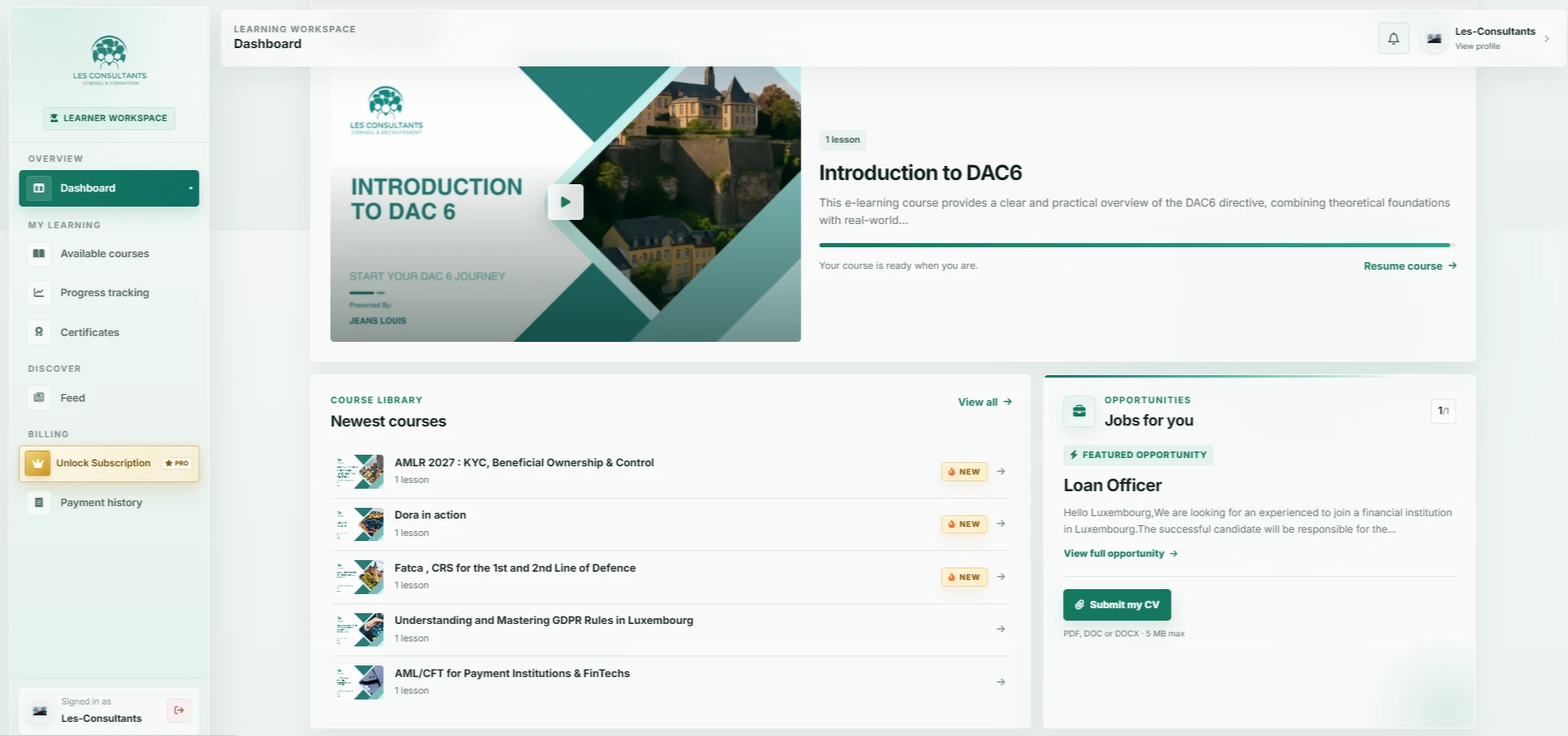
The e-learning platform in the Les-Consultants case study shows the value of a journey organised around a dashboard, a content library and progress tracking. This kind of experience requires careful thought about users, the data they see and the actions they can take.
You can also read our guide to custom business applications with Symfony to explore the subject further.
Budget, maintenance and SEO: what should you compare?
Budget depends on more than the technology you choose. The number of features, the level of customisation, integrations and the support you need all affect the cost.
| Criterion | WordPress | Symfony |
|---|---|---|
| Required features | Common features available through the CMS or plugins | Features developed around the rules of the project |
| Content management | An interface is generally available quickly | An administration interface designed for your needs |
| Integrations | Possible through plugins or specific development | Developed specifically for the tools involved |
| Initial budget | Can be contained for a standard scope, but varies with customisation | Often higher when the application is entirely bespoke |
| Recurring costs | Hosting, updates, theme and plugin maintenance | Hosting, bug fixes, feature development and technical maintenance |
| Maintenance | Monitoring the CMS, plugins, theme and compatibility | Monitoring code, dependencies, infrastructure and features |
| Future development | Fits within the CMS and chosen plugins | Architecture can evolve to meet specific project needs |
| Project handover and code access | Check the themes, plugins and custom developments involved | Agree on documentation, the code repository and technical access |
Search engine optimisation does not simply depend on choosing WordPress or Symfony. Key factors include:
- The quality and relevance of the content;
- Page structure;
- Properly organised titles and tags;
- Loading speed;
- The mobile experience;
- Internal links;
- Accessibility;
- The ability to develop the website further.
A well-designed solution can support SEO regardless of its technology. To plan the overall budget, you can also read our guide to business website costs in Strasbourg, bearing in mind that each project must be assessed against its actual scope.
Questions to ask before choosing
Before deciding between WordPress or Symfony, clarify the following points:
- Who will use the website or application? Visitors, customers, employees, administrators or several user groups?
- What actions should be possible? Reading content, requesting a quote, ordering, tracking a request, uploading a document or managing a process?
- Which tools need to be connected? A CRM, ERP, accounting software, payment solution, email marketing tool or external API?
- Who will edit the content? Someone without technical skills, a marketing team, several contributors or an internal administrator?
- What future changes do you expect? New users, a customer portal, subscriptions, automations, a mobile application or expansion into other countries?
- What support will you need after launch? Maintenance, security, development, hosting, training or regular assistance?
These answers often help distinguish a primarily editorial need from an application requirement. In some cases, a hybrid approach may be worth exploring, such as a CMS for public content and a dedicated application for business features.
Key figures
- More than 43% of the web, according to WordPress.org — Websites using WordPress.
- More than 600,000 developers in over 120 countries, according to Symfony — The Symfony community.
Conclusion
Choosing between WordPress or Symfony should start with your use cases, users and medium-term objectives. WordPress can serve many editorial and institutional projects effectively. Symfony becomes relevant when your business needs tailored processes, roles, integrations or a custom business application.
To clarify the features, technical constraints and next steps, tell OptiWebSolutions about your project. Nikoloz Mamyan can discuss your project in Strasbourg and Alsace, remotely throughout France, or with French-speaking clients across Europe.